
Ethereum is an open-source, decentralised blockchain platform whose native currency, Ether (ETH), can be used to pay for goods and services, trade against other cryptocurrencies, and power the smart contracts behind decentralised applications (DApps) and decentralised finance (DeFi). Because Ether trades around the clock on markets worldwide, its price in Canadian dollars (CAD) is always moving. Below you will find recent ETH to CAD quotes, the forces that drive them, and practical guidance on buying, trading, and storing Ether in Canada.
Current Ethereum Price in CAD
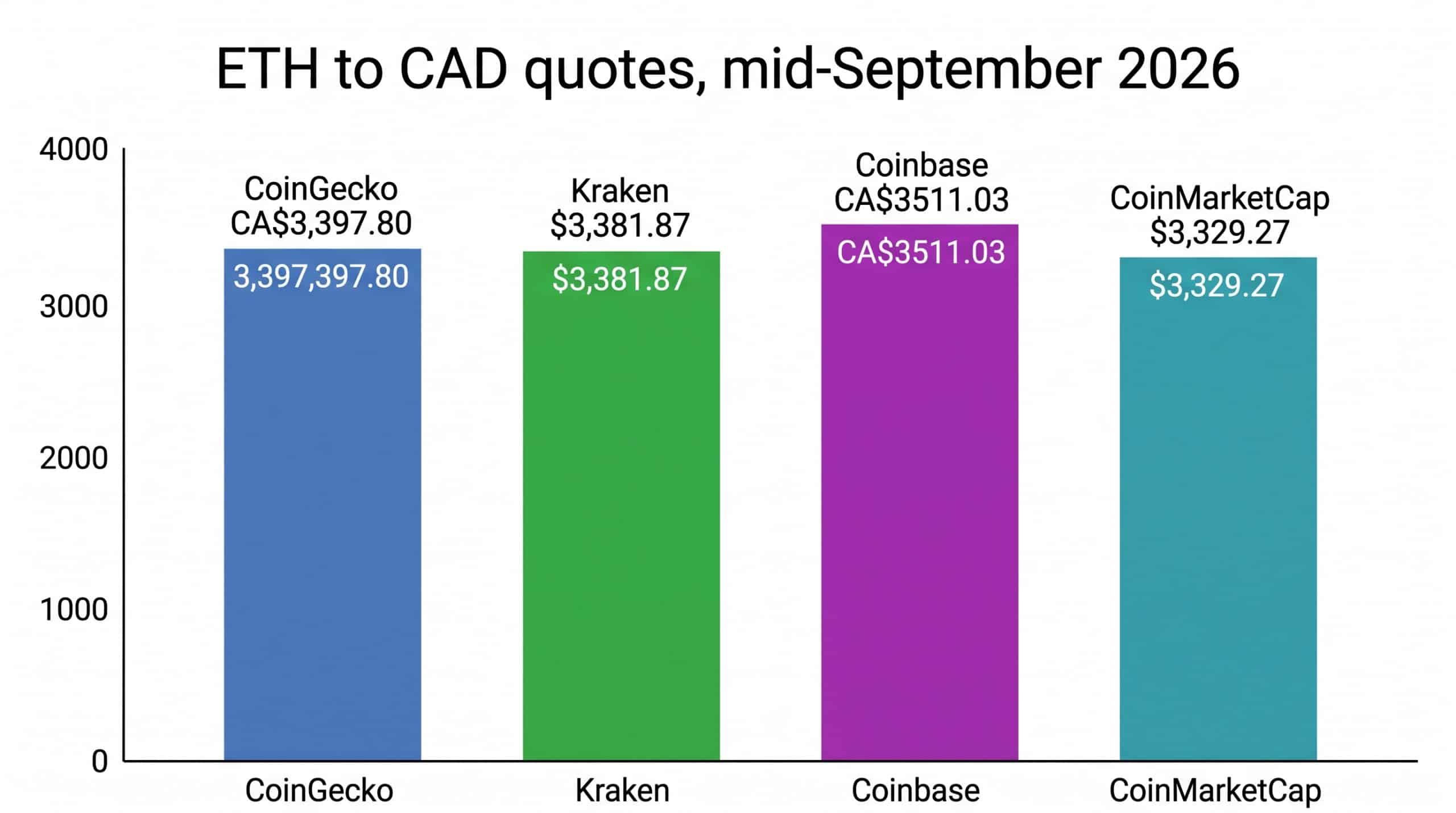
Ether’s CAD price varies slightly from platform to platform at any given moment, so the most reliable figure is always the live quote on the platform you actually plan to use. In mid-September 2026, major trackers and exchanges quoted the following:
- CoinGecko listed the ETH to CAD conversion rate at CA$3,397.80 for 1 ETH.
- Kraken quoted $3,381.87 CAD per ETH on its Canadian price page.
- Coinbase showed Ether at CA$3511.03 for Canadian users.
- CoinMarketCap reported an ETH to CAD rate of $3,329.27.
Small differences between platforms are normal: each quote is a snapshot taken at a slightly different moment. Treat any published number as a point-in-time reference and confirm a live price before you trade.
Ethereum Price History
Ether has been volatile since Ethereum’s launch in 2015. During the 2017–2018 market cycle, the price climbed above $1,300 USD in January 2018 before falling below $200 USD by December 2018. Sharp swings in both directions have remained a defining feature of the asset ever since, which is why careful investors study volatility rather than assuming past trends will continue.
What Moves the ETH to CAD Price
Several forces shape Ether’s value in Canadian dollars:
- Supply and demand. The amount of Ether available for sale, investor speculation, and overall confidence in the currency all feed directly into the price.
- Investor sentiment and economic trends. News coverage, public opinion of digital currencies, and broader economic conditions influence how willing people are to buy or sell.
- Technological developments. Improvements to blockchain technology or changes to smart contract protocols can lift demand by enabling new applications.
- Trading volume and liquidity. When more people trade an asset, the added liquidity can drive its overall value in the markets.
Ethereum’s market capitalisation — the circulating supply multiplied by the current price — is a useful indicator of how the asset is performing relative to others. Traders also lean on volatility analysis and technical analysis, using tools such as trend lines, moving averages, support and resistance levels, and trading volume to judge whether Ether looks overbought or oversold.
Where Canadians Trade Ethereum
Coinsquare, Kraken, and Bitbuy are among the most popular exchanges for trading Ethereum in Canadian dollars, and all of them support buying and selling Ether directly with CAD. Coinbase also publishes CAD pricing and serves Canadian customers. Each platform has its own fee schedule, coin selection, and liquidity profile, so compare them against your own needs before committing funds.
How to Buy Ethereum in CAD
Buying Ether in Canadian dollars is straightforward. Choose an exchange that supports fiat-to-crypto trading pairs in CAD, fund your account with cash or a credit or debit card, and place your purchase. Once you hold Ether, decide where it will live: leaving it on the exchange is convenient for active trading, while moving it to a wallet you control gives you more security for longer-term holdings.
Ethereum Wallets
Wallets fall into a few broad categories, each with its own trade-offs. Web wallets are hosted online by third parties and are convenient but more exposed to hacking attempts. Mobile and desktop wallets keep funds on your own device, which is more secure than a hosted service but still vulnerable if the device is stolen, hacked, or infected with malware. Hardware wallets store keys on a dedicated physical device and are relatively safe from online attacks, though they can be physically lost or damaged. Paper wallets keep keys entirely offline and offer strong privacy, but they are easily destroyed by water or fire. For meaningful sums, offline options such as hardware or cold storage wallets are the safer choice.
Advantages and Risks
Ethereum’s appeal starts with decentralisation: transactions settle without a middleman or reliance on a bank or government institution, and smart contracts automate processes around digital assets without intermediaries. The flip side is risk. Prices move quickly and there is no central regulating authority, online platforms can attract fraudsters and scammers, and exchanges and wallets can be targeted by hackers. Sensible mitigations include diversifying your investments, using stop-loss orders and setting firm limits on how much you are willing to lose in a single trade, sticking to trusted exchanges backed by reputable organisations, enabling multi-factor authentication, and keeping long-term holdings offline in cold storage.
Regulation and Taxes
Before investing, familiarise yourself with the rules that apply where you live. Cryptocurrency activity can carry tax reporting obligations, anti-money-laundering (AML) and know-your-customer (KYC) compliance requirements, and potential capital gains taxes when Ether is exchanged into fiat currency. Failing to comply can result in serious penalties, so keep records of your transactions and stay current on local requirements. This is general information, not financial or tax advice.
Ethereum Alternatives
Ethereum is not the only option for digital transactions. Bitcoin, the first decentralised peer-to-peer digital currency, offers strong encryption and an inexpensive way to send money across borders. Litecoin positions itself as a reliable medium of exchange, with faster and cheaper transactions than Bitcoin. Ripple focuses on global payments and money transfers with low transaction fees. Ethereum stands apart from all of them through its emphasis on smart contracts, decentralised applications, and wide acceptance across the crypto ecosystem.
Final Thoughts
Any Ether price in CAD you see published is a snapshot that ages quickly. Check a live quote on CoinGecko, Kraken, Coinbase, CoinMarketCap, or the Canadian exchange you use before making decisions, expect quotes to differ slightly between platforms, and pair any position with secure storage and a clear understanding of your tax obligations. Volatility cuts both ways, so invest only what you can afford to lose.