Ethereum is an open-source blockchain platform for smart contracts and decentralized applications, and its native currency, Ether (ETH), ranks among the most popular cryptocurrencies in the world. For investors in Canada, the price that matters is the price in Canadian dollars, not the U.S. dollar figure that dominates most crypto coverage. This analysis looks at where ETH-CAD stands right now, how the pair has performed recently and historically, and what Canadians should weigh before buying, storing, or reporting Ethereum.
Ethereum at a Glance
Ethereum was created by Vitalik Buterin in 2013 as a way to facilitate payments without third-party intermediaries or centralized authorities. The network runs on custom-built blockchain software and supports smart contracts, agreements that execute only when all parties have consented and whose terms are recorded on the blockchain ledger, making them difficult to alter. It also hosts decentralized applications that store data securely with no central authority overseeing operations. Ether itself can be used to purchase goods and services and to send money across borders, which has helped make it widely accepted and has drawn developers from many industries onto the platform.
Where ETH-CAD Stands Today
Canadian-dollar quotes for Ethereum are broadly consistent across major data providers, though each platform shows a slightly different figure. Yahoo Finance quotes ETH-CAD at 3,380.77, and CoinGecko lists the conversion rate at CA$3,373.39 for every ETH. Kraken reports the Ethereum price in Canada at $3,381.87, alongside an Ethereum market cap of $413,033,880,545, while Coinbase shows the price at CA$3,360.17. Because quotes move constantly and differ slightly by platform, always check the exchange you actually trade on before placing an order.
Recent ETH-CAD Performance
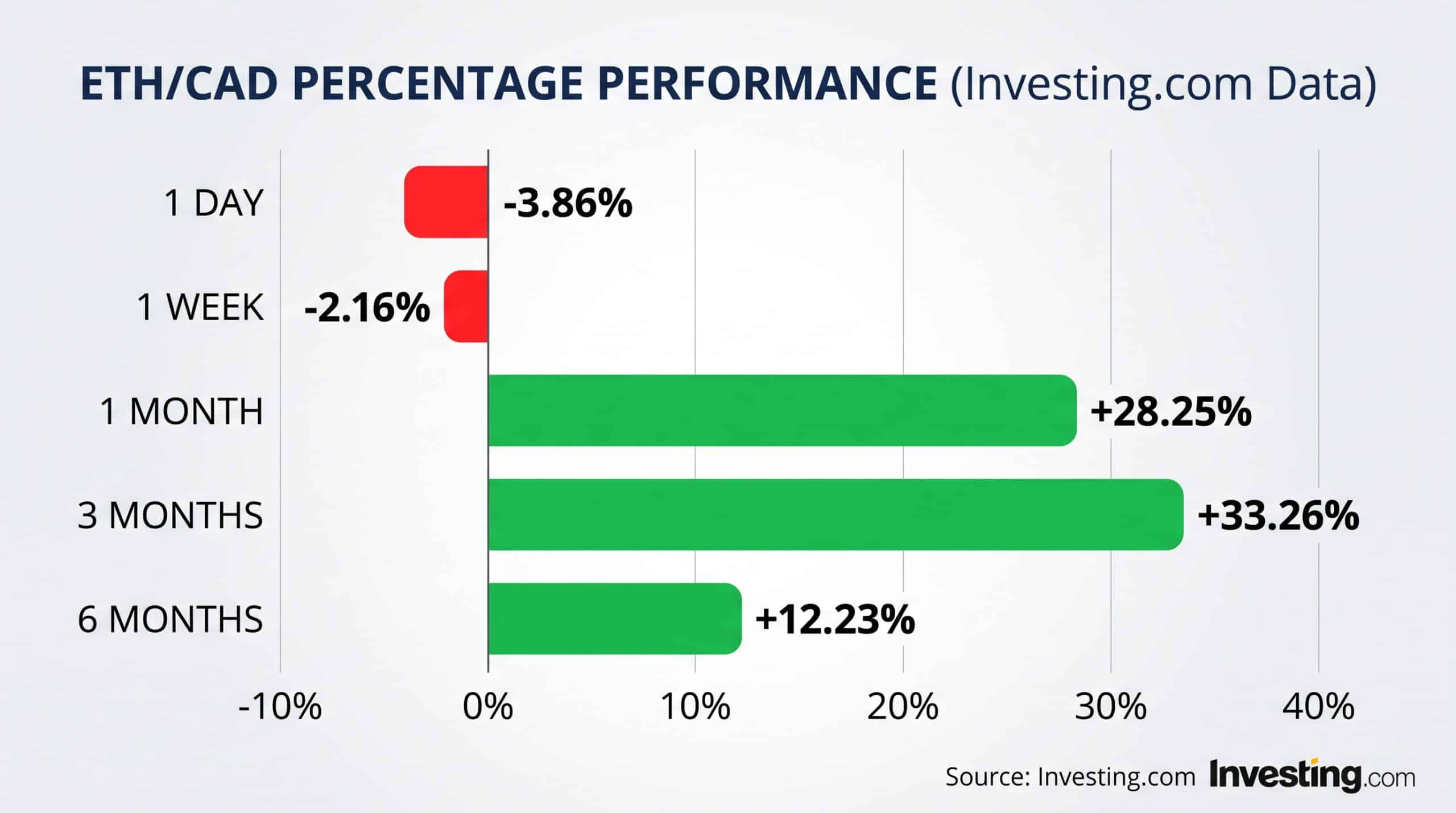
Short-term momentum has been mixed, but the multi-month trend has favoured buyers. Investing.com data shows ETH/CAD at -3.86% over 1 day and -2.16% over 1 week, but +28.25% over 1 month, +33.26% over 3 months, and +12.23% over 6 months. The longer view is less flattering: Trading Economics lists the pair’s yearly change at -45.81%. Taken together, the data describes a market that has climbed over recent months while still sitting below where it stood a year earlier.
A Volatile History
Volatility is nothing new for this asset. In December 2017, Ethereum reached an all-time high of over $1,000 USD, but by April 2018 it had decreased by more than 70% to below $300 USD. The Canadian-dollar record from early 2018 shows the same whiplash: ETH traded at 566 CAD on Jan 1, climbed 7.6% to 609 by Feb 1, surged 32% to 807 by Mar 1, then dropped 31% to 497 by Apr 1. Swings of that magnitude are a reminder that cryptocurrency prices can move sharply in either direction regardless of geography or currency denomination, and that staying on top of current trends matters for anyone holding digital assets.
What Moves the Price
Several forces shape Ethereum’s value. Economic trends such as inflation and deflation change the cost of goods and services over time, which feeds through to asset prices. Market volatility reflects rapid changes in supply and demand: more buyers than sellers pushes the price up, while more sellers than buyers pushes it down. Technological advancements can lift the price by increasing user adoption or by adding features that improve usability or security, and speculation or regulatory changes can move prices quickly as well. Understanding these drivers helps investors interpret the sharp moves this market regularly produces.
Buying Ethereum in Canada
Canadian cryptocurrency exchanges including Coinsquare, Kraken, Bitbuy, and MyBTC let users buy and sell Ethereum, and each platform differs in the features and fees attached to trading. Before choosing, compare exchange fees, the available payment methods (depending on the platform these can include credit cards, bank wires, or Interac e-transfers), the exchange’s reputation, and its security measures. Beyond direct purchases, exposure can also come through instruments such as futures contracts, options, and other derivatives, each with its own risk profile. Whatever the route, tailor the strategy to your own goals and risk tolerance: buy-and-hold suits investors seeking steady long-term exposure, while short-term trading demands close attention to news and a disciplined risk management system.
Storing Your Ether
Wallet choice matters as much as exchange choice. Cold storage wallets keep private keys offline on a physical device; software wallets act as an interface for interacting with the blockchain; paper wallets let users print private key information and keep it somewhere secure; and hardware wallets are specialized devices built specifically for storing cryptocurrency safely. Many wallets also add protections such as multi-signature technology and encryption protocols. Each type balances security, ease of use, and cost differently, so research the options thoroughly and match the wallet to your own risk tolerance before moving funds.
Taxes and Regulation in Canada
There is no single unified law governing Ethereum in Canada; instead, several agencies each oversee a piece of the picture. The Canadian Revenue Agency (CRA) requires citizens who invest in digital assets to report profits or losses on their income tax returns. The Financial Transactions and Reports Analysis Centre (FINTRAC) enforces anti-money laundering requirements, the Investment Industry Regulatory Organization (IIROC) regulates brokers dealing in securities, and provincial securities commissions oversee cryptocurrency trading platforms operating in their jurisdictions. Tax treatment is complex because Ethereum does not fit neatly into either the commodity or the security category: profits from buying and selling Ether may be subject to capital gains tax, while Ether that is mined or used to purchase goods and services might be treated as income. Keep accurate records of every transaction and consult a qualified tax professional to stay onside with the rules.
Ethereum vs. Bitcoin
Both are decentralized digital currencies, but they serve different purposes. Bitcoin, around since 2009, functions primarily as a digital currency, while Ethereum is a platform that uses blockchain technology to power smart contract applications, including decentralized finance tools such as wallets, exchanges, and lending services. Transactions on the Ethereum network require gas fees for processing, whereas Bitcoin’s blockchain network does not use gas fees. Understanding these differences matters when deciding which asset, if either, fits your portfolio.
Risks Worth Weighing
Ethereum offers real advantages: greater accessibility than many traditional investments, low transaction fees, faster processing times than Bitcoin, and decentralized control over your own funds. The risks are just as real, though. Prices are highly volatile, liquidity can vary, the network has faced scalability constraints, and the open-source ecosystem carries potential security risks. Most tokens are not backed by tangible collateral, leaving them more exposed to manipulation, and cryptocurrency markets remain largely unregulated compared with traditional securities. Diversifying across asset classes, including for some investors other cryptocurrencies such as Bitcoin or Litecoin, and doing thorough research before committing funds are the most practical defences.
The Bottom Line
Ethereum’s Canadian-dollar price has climbed meaningfully over recent months even as the year-over-year comparison remains negative, and its history shows how quickly those numbers can change. If you are considering a position, verify the live ETH-CAD quote on your chosen exchange, understand the fee, payment, and wallet options available to you, keep records for the CRA, and size any investment to a level of volatility you can genuinely tolerate.