
In the fast-paced world of cryptocurrency technology, the Ripple platform continues to make significant waves across global financial markets. This blockchain-based payment protocol is reshaping how digital transactions are conducted internationally, and its approach to cross-border payments has captured the attention of banks, financial institutions, and tech enthusiasts worldwide.
Ripple’s native cryptocurrency, XRP, remains a focal point for investors and blockchain specialists who are watching its potential to transform traditional monetary systems. From regulatory milestones to technological advances, the Ripple ecosystem offers a compelling narrative of innovation and disruption in financial technology.
Key Takeaways
- Innovative blockchain technology: Ripple’s payment protocol enables fast, secure, and cost-effective cross-border transactions, with settlement in 3-5 seconds.
- XRP cryptocurrency: minimal transaction fees of 0.00001 XRP per transaction position XRP as a competitive digital asset in the evolving cryptocurrency ecosystem.
- Global financial partnerships: Ripple works with over 300 financial institutions, including major names like Santander and American Express.
- Regulatory landscape: after a partial court victory in July 2023, the SEC ended its lawsuit against Ripple in August 2025, according to Reuters.
- Technological innovation: a unique consensus protocol, decentralized network architecture, and strategic expansion into emerging financial markets continue to drive Ripple’s potential.
What Is Ripple and XRP?
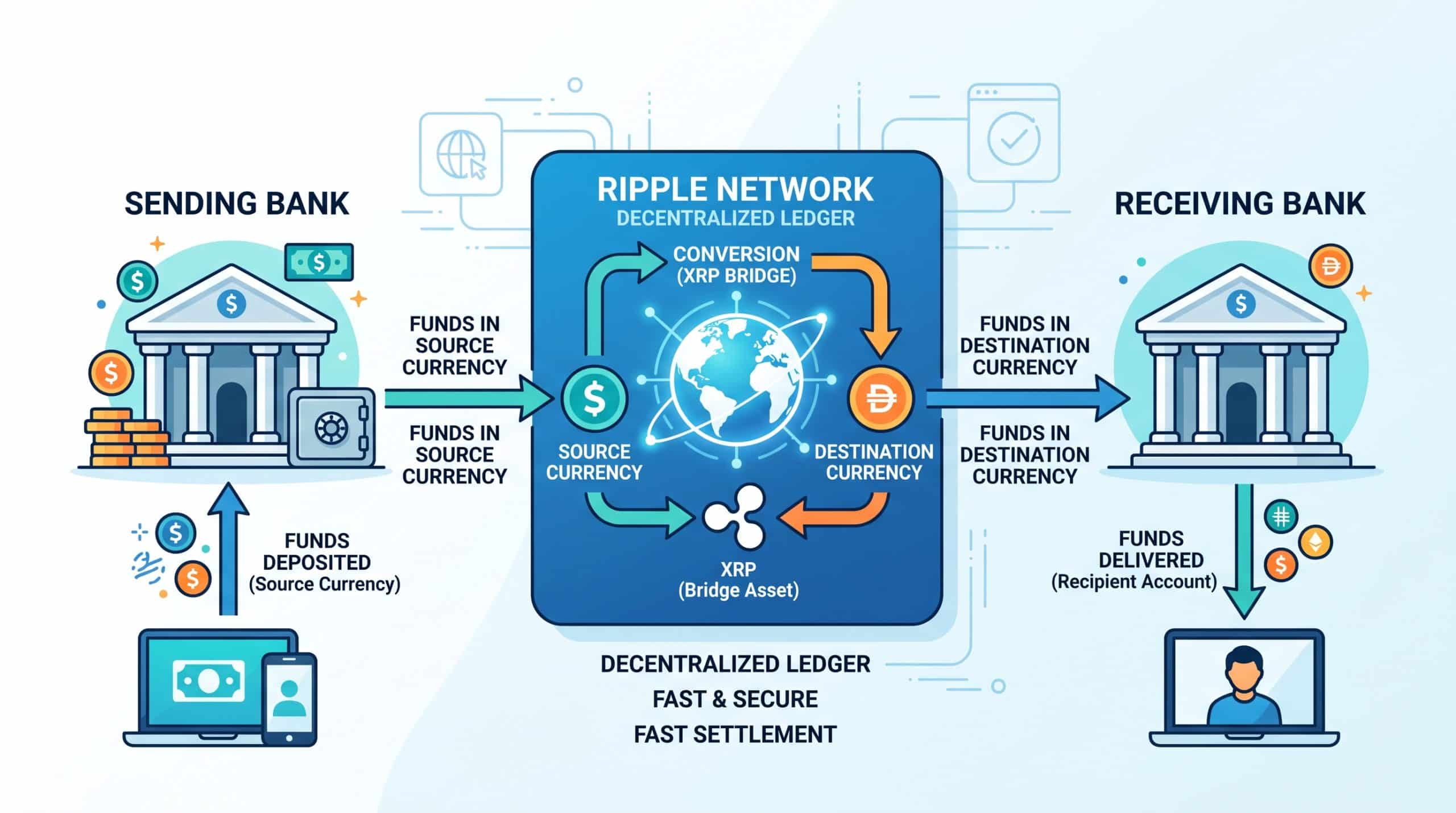
Ripple is a digital payment protocol designed to facilitate seamless global financial transactions. The platform leverages blockchain technology to enable fast, secure, and cost-effective cross-border money transfers, with the XRP cryptocurrency serving as a bridge asset within the network.
History of the Cryptocurrency
Ripple emerged in 2012 as a blockchain-based payment system developed by Chris Larsen and Jed McCaleb, with a mission to resolve inefficiencies in traditional international money transfers. Key milestones include:
- 2012: Initial platform development and creation of the XRP cryptocurrency
- 2014: Significant venture capital investments from financial institutions
- 2017: Extensive bank partnerships and global expansion
- 2020: Strategic regulatory compliance and increased global adoption
Key Technological Features
- Consensus protocol: a distributed agreement mechanism verifies transactions faster than traditional blockchain networks and eliminates energy-intensive mining.
- Transaction speed: transfers settle in 3-5 seconds, and the network supports approximately 1,500 transactions per second, far beyond Bitcoin’s 7 transactions per second.
- Cost efficiency: fees of 0.00001 XRP per transaction reduce intermediary banking costs and keep the fee structure transparent.
- Decentralized network: a distributed validator network allows independent validation by multiple participants and supports transaction integrity.
Recent Market Developments
Price Trends
XRP has been under pressure lately. According to FXStreet’s XRP coverage, the token was recently trading below $1.05 after declining for a fourth consecutive day. As always in digital asset markets, price levels change quickly, and traders weigh regulatory developments and broader cryptocurrency sentiment alongside the charts.
Ecosystem and Product News
Ripple’s footprint now extends beyond payments. The company’s official X account announced that its RLUSD stablecoin joined the Gate ecosystem for trading. In parallel, Ripple’s press center lists recent announcements including Ripple Treasury’s governed AI for enterprise treasury and Ripple Prime’s launch of a Delta One business that expands its equity derivatives capabilities.
Investor Sentiment
Institutional perspectives toward Ripple reflect cautious optimism. Regulatory clarity continues to influence investment decisions, blockchain integration projects keep attracting professional capital, and ongoing technological innovation supports longer-term confidence. Institutional investors focus in particular on Ripple’s potential in global payment infrastructure.
Regulatory Landscape
Ripple’s journey through the global regulatory environment has been complex and marked by significant legal scrutiny, with the SEC case standing out as the defining chapter.
The SEC Case
The SEC v. Ripple lawsuit centered on the classification of XRP as a security and became one of the most closely watched legal battles in the cryptocurrency industry. Ripple secured a partial victory in July 2023, and, as Reuters reported, the SEC ended its lawsuit against Ripple in August 2025.
Global Regulatory Perspectives
International approaches vary by jurisdiction. In the United States, the SEC litigation has now concluded. In the European Union, MiCA regulations are emerging as the framework for digital assets. The United Kingdom has been cautiously supportive of blockchain innovation, while responses across the Asia-Pacific region remain mixed. Ripple’s compliance strategy involves proactive engagement with regulators as it works toward clear legal frameworks for integrating blockchain technology into mainstream finance.
Blockchain Technology Innovations
Cross-Border Payment Solutions
Ripple’s payment protocol processes cross-border transfers in 3-5 seconds, reducing traditional banking transfer times from days to moments. Real-time transaction verification, minimal fees of 0.00001 XRP per transfer, cryptographic security protocols, and a decentralized network architecture underpin the system.
Banking and Financial Industry Adoption
Financial institutions integrating Ripple’s technology can reduce transaction processing costs by up to 70%, eliminate intermediary banking complications, enhance transparency in global transfers, and settle payments rapidly. The RippleNet network gives institutions a standardized framework for cross-border transactions, bridging existing financial systems with blockchain capabilities.
Partnerships and Collaborations
Ripple has established connections with over 300 financial institutions worldwide. Notable examples include Santander, which implemented cross-border payment solutions using RippleNet; American Express, which explored blockchain transaction processing for international payments; and Standard Chartered, which developed real-time settlement mechanisms.
Expansion continues across Asia-Pacific financial markets, European banking networks, Latin American payment corridors, and Middle Eastern financial technology sectors, with a focus on markets where traditional payment systems are least efficient.
Future Outlook
Ripple’s trajectory remains dynamic within the global financial technology landscape. Growth pathways include accelerating institutional adoption and rising cross-border transaction volumes; regulatory compliance frameworks built through proactive engagement with international bodies; and continued technological enhancement, from network scalability and cross-blockchain interoperability to advanced cryptographic security such as quantum-resistant encryption techniques.
Conclusion
Ripple represents a transformative approach to global financial systems: a technology changing not just how money moves but the infrastructure of international transactions. Its strategic partnerships, blockchain innovations, and the resolution of its long-running SEC case position Ripple as a significant player in the future of digital finance, and one worth watching as financial technology continues to evolve.
Frequently Asked Questions
What is Ripple and how does it work?
Ripple is a blockchain-based payment protocol designed to facilitate fast, secure, and cost-effective global transactions. It operates through a decentralized network that enables near-instantaneous cross-border transfers, using a consensus mechanism to verify transactions quickly while eliminating intermediaries and reducing costs.
What is XRP and how is it related to Ripple?
XRP is the native cryptocurrency of the Ripple network. It serves as a bridge currency that enables rapid exchanges between different financial systems and is designed specifically for payment settlement, with transaction times of 3-5 seconds and low fees.
How secure is the Ripple network?
The network relies on decentralized blockchain technology and cryptographic protocols. Its consensus mechanism validates transactions across multiple independent nodes, and partnerships with over 300 financial institutions reflect confidence in its security standards.
What makes Ripple different from other cryptocurrencies?
Ripple focuses on practical financial solutions rather than speculative trading. Its differentiators include fast transaction speeds, minimal fees, direct bank integrations, and a consensus protocol that does not require energy-intensive mining.
How are financial institutions using Ripple’s technology?
Institutions use Ripple’s blockchain to streamline international payments, reduce processing costs by up to 70%, and remove complex intermediary steps. Banks like Santander, American Express, and Standard Chartered have worked with RippleNet to enable faster, more transparent cross-border transactions.
What happened with the SEC lawsuit?
Ripple was in a long legal battle with the SEC over whether XRP should be classified as a security. Ripple achieved a partial victory in July 2023, and Reuters reported that the SEC ended its lawsuit against Ripple in August 2025.
What is RippleNet?
RippleNet is Ripple’s global payment network connecting financial institutions worldwide. It provides a standardized infrastructure for cross-border transactions, reduces settlement times from days to seconds, and supports multiple currencies as a bridge between traditional banking systems and blockchain technology.
How volatile is XRP’s price?
XRP’s price moves with regulatory developments, technological progress, and broader cryptocurrency trends. Per FXStreet, the token was recently trading below $1.05 after a fourth consecutive day of declines, so any price level should be treated as a snapshot in time.
How can someone start investing in Ripple?
Individuals can purchase XRP through major cryptocurrency exchanges such as Coinbase, Binance, or Kraken. It is sensible to use a secure digital wallet, research market trends, understand the platform’s fundamentals, consider risk tolerance, diversify, and stay informed about regulatory developments.